BARBARA SZLESZYŃSKA-MALEC was born on May 31, 1942 in the town of Aryk-Balyk in Kazakhstan. In 1946 she returned to Poland with her parents and her brother born in 1945. Mrs. Barbara doesn't remember much from those years, but she knows well the history of the whole family: both on her mother's side - Dukarski, and on her father's side - Szleszyński.
From these families, the NKVD deported 17 people deep into Russia ...and all of them returned to Poland. Her grandparents, Cecylia and Kazimierz Dukarski lived in Pinsk (currently the town in Belarus). Grandfather worked in the prison service, and grandmother was a housewife who raised six children - five daughters and a son. The eldest was 18-year-old Stefania (later - mrs. Barbara's mother). On September 17, the NKVD arrested her grandfather and they never heard from him again.
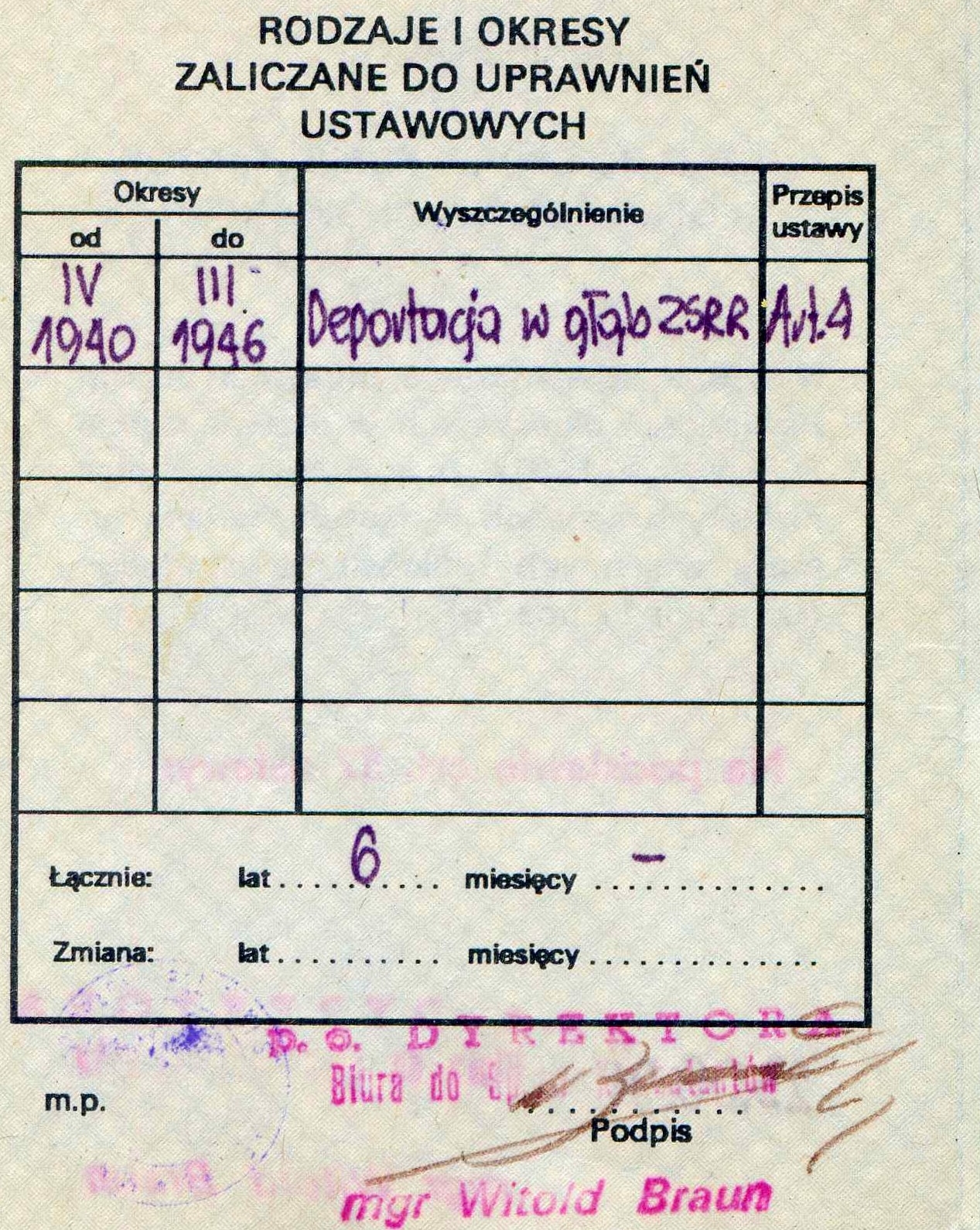
On April 13, 1940, during the second deportation of Poles (the first was in February), her grandmother with six children was transported to Kazakhstan. The journey in a cattle wagon with 30 people lasted 3 weeks. They got off in Kokshetau. Dukarski family drove by car to the destination town - Imantau. They were accommodated in the house of Lampea Kuchma, in an empty room, without furniture and without a floor.
The three oldest daughters were employed in a kolkhoz, 17 km away. Grandma looked after the children, sewed, embroidered and knitted clothes for the neighbors. Village women paid with food.
Mrs. Barbara's father, Wincenty Szleszyński, came with his sisters to Kazakhstan in the same transport from Pinsk. The Russians accommodated his family in the town of Zolotaya Gorka. He met Stefania and they got married in August 1941.
A year later, on May 31, Mrs. Barbara was born. In 1944, when mrs. Barbara's mother was pregnant again, her father was conscripted into the Soviet Red Army. He fought on the southern front, he was wounded near Budapest. When it was possible, he came back to Kazakhstan to take his wife and children and together they returned to Poland in 1946.
Two years earlier (in 1944 Poles could change their place of residence) Cecylia Dukarska and her family were assigned to Sarny. When they got there, it turned out that they were able to return to Poland. By chance, they settled in Zamość. Within two years, the Szleszyński family also came to Zamość.
Mrs. Barbara spent her childhood in the Old Town of Zamość. She attended the nearby primary school, and later to the secondary school. She worked in the Zamość Town Hall all her working life. Currently she is retired. She has one son and one grandson. Since 2002, he has been the President of the Board of the Siberian Exiles Union’s Branch in Zamość. Earlier, since the organization was reactivated in 1988, this function was performed by her sisters.
Exiles, deportations and other forms of Soviet repressions on Poles between 1939 and 1941 and their consequences until 1956:
1. 1st September 1939 – the beginning of World War II – Nazi aggression on Pola
2. 17th September 1939 – the Soviet Union breaks the nonviolence agreement. The Red Army marches on Polish territory in accordance to a secret agreement between Nazi and Soviet war ministers: Ribentropp and Molotov. The consequence of this event was partition of Poland between two totalitarian regimes.
By taking part in the partition of Poland, the Soviet Union acquired over 190 sq. km of land with about 13 million people. Among them were about 5 million Poles. The rest consisted of Ukrainians, Belarusians and Jews.
The amount of Polish victims who were caught under Soviet occupation between 1939 and 1941 is still not fully known. It is believed that during this two-year period over 1 million people were represed by either shooting, imprisonment, work camps or exiles (…). No less than 30 thousand were shot and the mortality rate amont the exiled (mostly to Kazakhstan and Siberia) is believed to have reached about 8-10% which would amount to about 100 thousand dead.
3. The IV deportations
Soviet government, under Joseph Stalin's order, coducted 4 deportation actions of Polish citizens:
I - 10th February 1940 – 140 thousand people were deported, mostly civilians
II - 13th and 14th April 1940 – 61 thousand people, mostly so called “enemy of the state”: government officials, police officers, teachers, social activists, traders, industrialists and bankers. All of them with their families. A lot of women and children were deported back then.
III – May-July 1940 – 80 thousand people – mainly from Central Poland. A lot of Jews were deported back then.
IV – May-June 1941 – about 85 thousand people – mainly Polish inteligence, refugees and railway workers with their families. A lot of them were early arrested by the NKVD.
The first deportation done by the NKVD (February 1940) was conducted in inhuman conditions which many people haven't survived. The temperature reached as low -40 degreed Celsius.
The following 3 deportations were conducted during spring and summer and were not as devastating. People were given between 10 minutes and an hour to pack their belongings. Sometimes they weren't allowed to take anything with them. People were put into freight wagons with barred windows. Sometimes more than 50 people were put into just one cart.
The voyage took sometimes up to several weeks with terrible conditions. People died of cold, starvation or exhaustion. When arriving to their destination, the exiled were greeted by years of hard work, poverty, sickness and starvation.
The purpose of the deportation was to exterminate the Polish elite and the Polish population in general, they were to break the social structure and provide a totalitarian labor force for the Soviet empire.